






Breast cancer is one of the most common cancers affecting women worldwide — and it can occur at any age. At Thainakarin Hospital, our Comprehensive Breast Center offers advanced diagnostic and treatment services delivered by a multidisciplinary team of specialists — including breast surgeons, oncologists, radiologists, and specialized nurses — dedicated to providing personalized, compassionate care.
Understanding Risk Factors
Preventing breast cancer begins with understanding its risk factors. Women are encouraged to maintain a healthy lifestyle and avoid the following behaviors that can increase the likelihood of developing breast cancer:
- Unhealthy diet
- Obesity
- Alcohol consumption
- Sedentary lifestyle
Adopting healthy habits helps maintain hormonal balance and strengthen the immune system.
However, for some individuals, genetic factors also play a crucial role in breast cancer development.
Genetic Risk Groups
1. High-Risk Genetic Group (for patients diagnosed with breast cancer)
You may be considered at high genetic risk if you:
- Were diagnosed with breast cancer before age 50
- Have triple-negative breast cancer
- Are a male diagnosed with breast cancer
- Have a family history of breast, ovarian, pancreatic, or prostate cancer
- Were diagnosed with bilateral breast cancer
- Have at least two or more first-degree relatives with breast cancer
2. High-Risk Family History Group
You may also be at higher risk if you have:
- A similar family history as above, even without your own diagnosis
- A greater than 5% likelihood of carrying a BRCA gene mutation (as calculated by tools such as Tyrer-Cuzick, BRCAPro, or CanRisk)
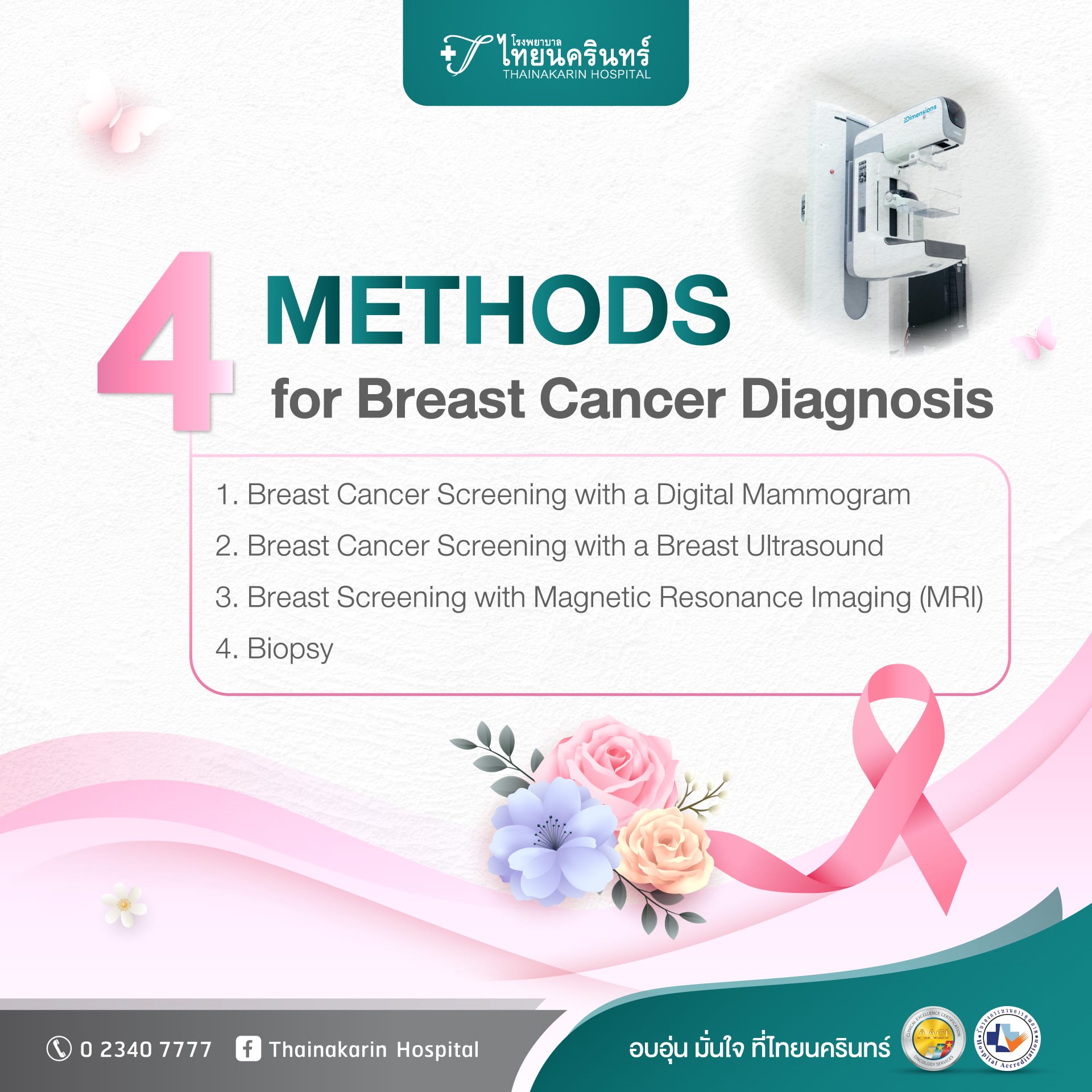
Early Detection Through Screening for Breast Cancer
At Thainakarin Hospital, we use state-of-the-art imaging technologies for comprehensive breast cancer screening and early detection. Our advanced diagnostic tools follow international breast cancer screening guidelines to detect abnormalities at the earliest, most treatable stages.
- Digital Mammogram – The gold standard for mammogram screening for breast cancer, using low radiation levels to capture high-resolution images. This technology enables breast cancer early detection by identifying microcalcifications often seen in the earliest stages.
- Breast Ultrasound – Radiation-free imaging suitable for young women and pregnant patients, useful for distinguishing cysts and tumors.
- Breast MRI – Highly sensitive for complex cases or genetic-risk screening.
- Biopsy – Tissue examination to confirm diagnosis when a suspicious lesion is found.
Biopsy Techniques
- Ultrasound-Guided Core Needle Biopsy: Performed by a breast imaging radiologist, offering results within 24 hours.
- Stereotactic-Guided Biopsy: Used when abnormalities are found in a mammogram, particularly for calcium deposits.
Personalized Breast Cancer Treatment
Our treatment philosophy focuses on precision, safety, and quality of life — combining modern medical technology with patient-centered care.
1. Breast-Conserving Surgery
Ideal for small or localized tumors. The affected tissue is removed while preserving the breast’s shape using oncoplastic techniques. This may be followed by radiation therapy.
2. Mastectomy with Reconstruction
If breast conservation isn’t possible, a total mastectomy is performed, followed by reconstruction using implants or the patient’s own tissue.
3. Sentinel Lymph Node Biopsy
Minimally invasive node removal using Isosulfan Blue or Indocyanine Green dye, reducing the risk of arm swelling and nerve damage.
Systemic & Radiation Therapies
Our team of medical oncologists and radiation oncologists provides comprehensive systemic therapies — including chemotherapy, immunotherapy, hormone therapy, and targeted therapy — tailored to each patient’s cancer stage, type, and genetic profile.
We use the Vital Beam Radiation Therapy System, offering precise and effective treatment with minimized side effects.
Rehabilitation and Recovery
Our Physical Medicine & Rehabilitation (PM&R) specialists assist patients in regaining strength, mobility, and confidence after treatment — helping reduce complications such as lymphedema or frozen shoulder, and improving long-term quality of life.
Highlights of Thainakarin’s Breast Cancer Center
- Tissue Biopsy Results within 24–48 Hours
- Oncoplastic Surgery Expertise – Aesthetic breast preservation even with multiple lesions
- Comprehensive Oncology Team – Collaborative care before and after surgery
- Personalized Rehabilitation Programs
- Vital Beam Radiotherapy System – Precision radiation targeting to minimize lymph node surgery and arm swelling
At Thainakarin Hospital’s Breast Center Bangna, every patient receives individualized care based on modern technology, expert diagnosis, and compassionate treatment.